When Behavior Breaks Down,
It's Not Defiance. It's Overload.
The STACK Model™ helps professionals understand what is happening before behavior escalates.
Built for educators, clinicians, behavior specialists, and support teams, the model gives you a practical way to recognize rising load, adjust demands in real time, and support regulation before capacity is exceeded.
Used by teams across school and clinical settings.
Developed by Dr. Mark Bowers.
You've Likely Seen This
In Your Own Work:
A student holds it together all morning, then explodes over something small.
A client shuts down halfway through a counseling session.
A child refuses a familiar task that they were able to complete the day before.
In the moment, these reactions can look sudden or confusing. But often, the behavior is not the beginning of the problem. It is the point where load has exceeded capacity.
Built for Professionals Working with Complex Behavior
If your work involves supporting students, clients, or families under stress, you have likely experienced:
Escalation without a clear warning
Inconsistent outcomes from the same strategies
Pressure to respond quickly without enough insight
Difficulty knowing whether to reduce demands, hold expectations, or change the environment
The STACK Model™ is designed for:
Educators and school-based teams
Therapists and clinicians
Behavior specialists
Support staff and interdisciplinary teams
Professionals involved in IEP, treatment, or support planning
The model helps you:
Recognize rising load before escalation
Adjust demands in real time
Support regulation without guesswork
Maintain expectations without pushing someone past capacity
Behavior is Often Interpreted Too Late
By the time behavior becomes visible, the underlying problem has often been building for a while.
What looks like a sudden reaction may be the final point of overload.
In many settings, intervention begins after behavior escalates:
When a student refuses
When a client shuts down
When a situation becomes disruptive
When the team is already under pressure to respond
At that point, the system is already starting to break down.
Behavior is not always the problem to solve.
Often, it is the signal that capacity has already been exceeded.
To change outcomes, professionals need a way to:
Recognize load before it peaks
Adjust demands before breakdown
Support regulation before escalation
The STACK Model™
Understanding How Load Builds
and Behavior Changes
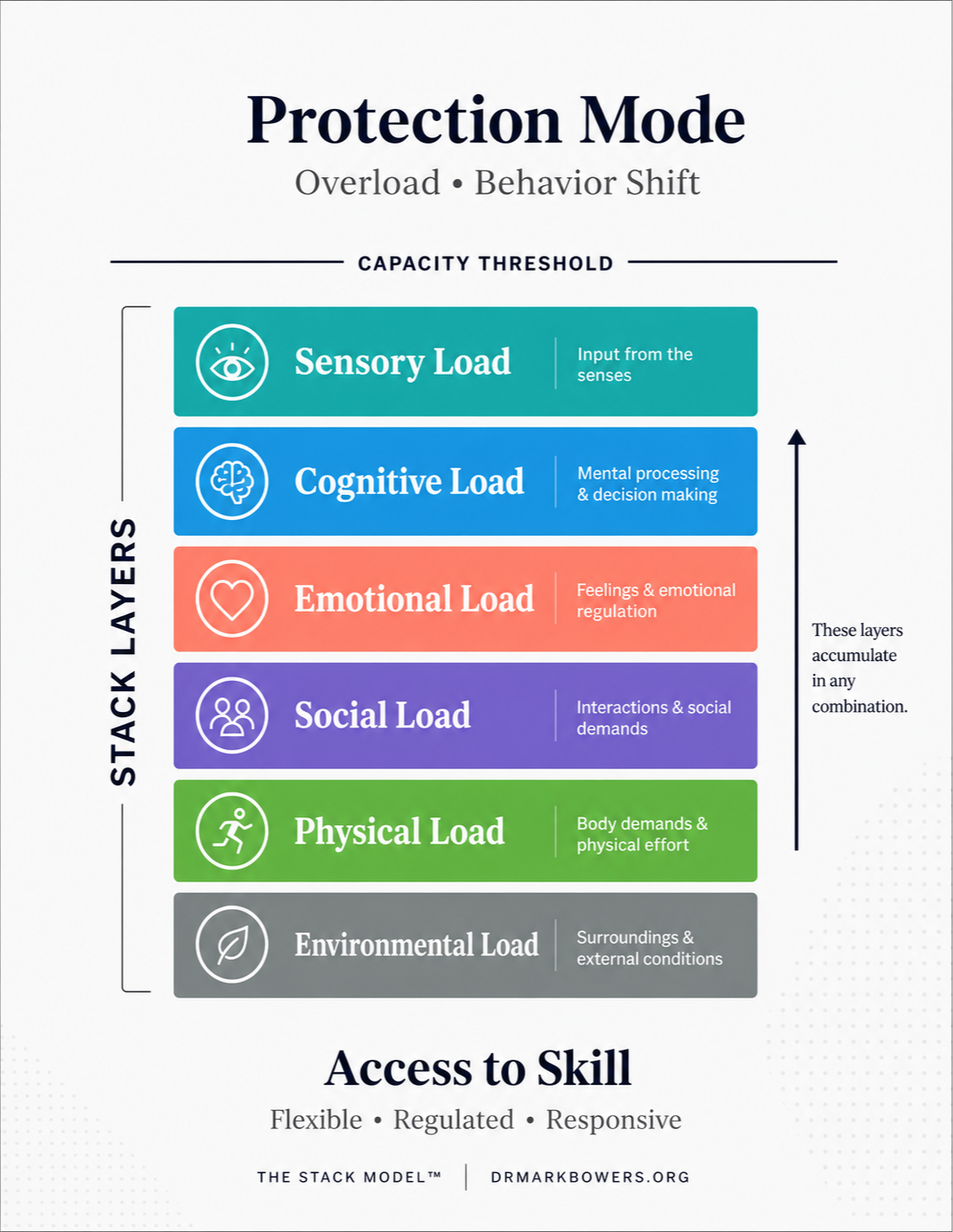
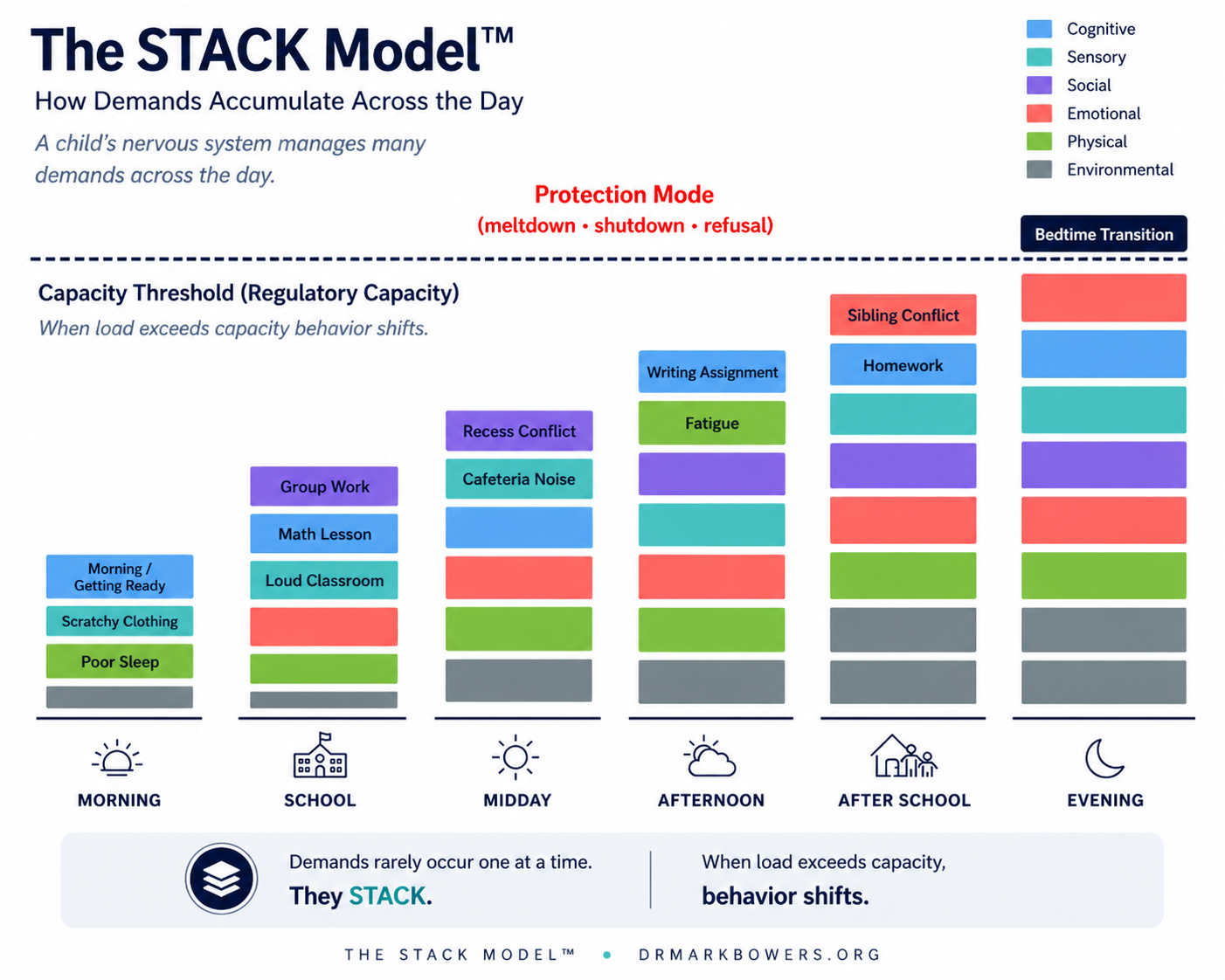
Every demand adds to a person’s load.
When total load exceeds capacity, behavior changes.
This does not mean the person has lost the skill. It means access to that skill has become harder under load.
This explains why someone can:
Seem fine, then suddenly not cope
Handle one demand, but not several at once
Use a skill in one setting, but not another
Lose access to skills they normally have
The goal is to recognize and adjust load before capacity is exceeded.
What Creates Load?
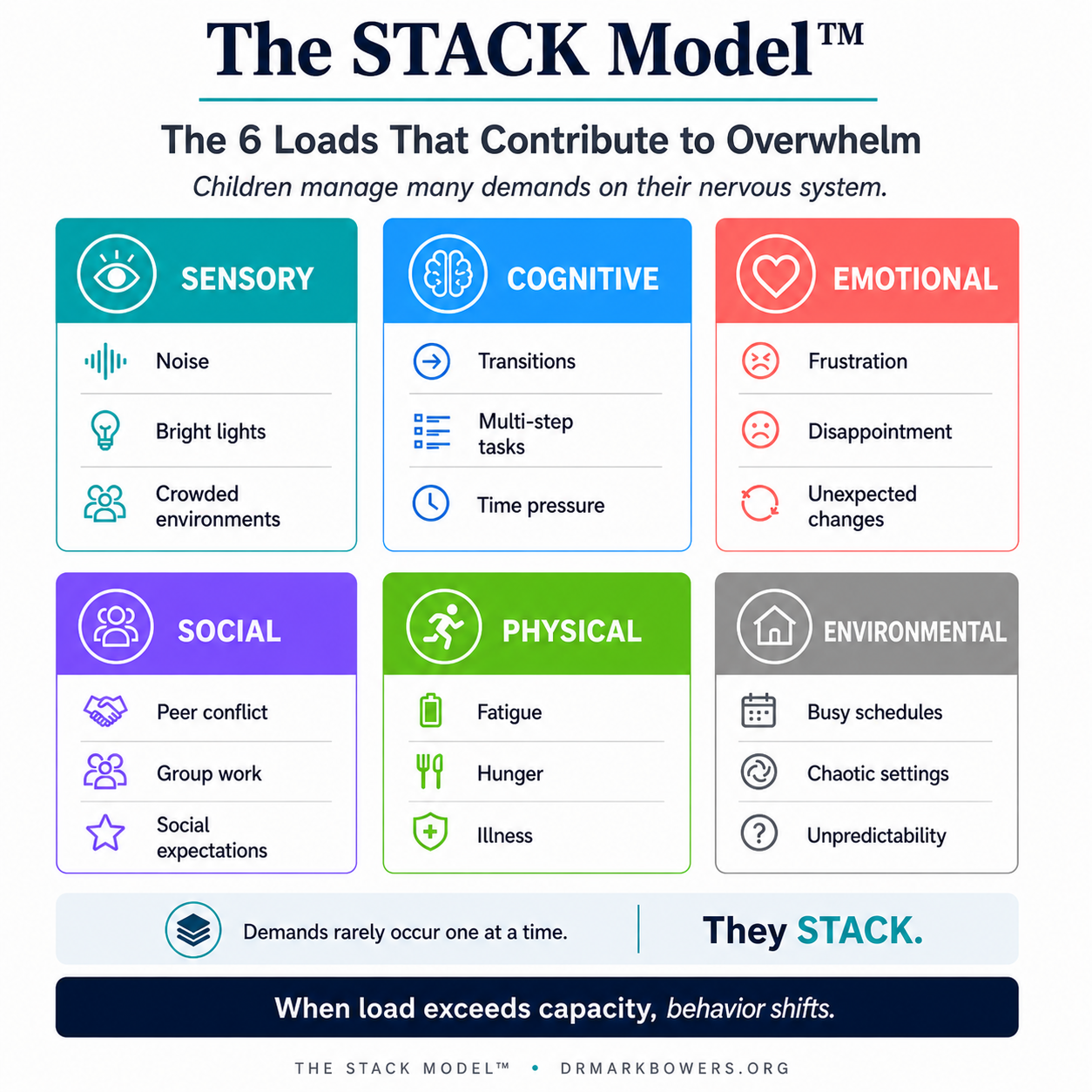
Load can come from many sources, including:
Sensory demands
Transitions
Social expectations
Cognitive effort
Emotional stress
Communication demands
Uncertainty
Fatigue
Masking
Accumulated demands across the day
A single demand may be manageable.
Several demands stacked together can exceed capacity.
Before Behavior Changes, There are Usually Early Signs
As load builds, there are often subtle shifts before escalation.
These may include:
Increased rigidity
Changes in voice tone
Slower processing
Withdrawal or avoidance
More frequent “no” responses
Trouble starting or completing familiar tasks
Reduced flexibility
Increased need for control or predictability
These signs often appear before behavior breaks down.
Recognizing them early gives professionals a chance to reduce load before capacity is exceeded.
What Makes This Framework Different
Most behavior approaches begin after behavior happens.
They often focus on:
Correcting actions
Teaching skills
Increasing expectations
Managing the visible behavior
The STACK Model™ focuses on what happens before behavior.
Instead of asking, “How do we respond to this behavior?”
It asks, “What load led here, and what needs to change?”
This shift helps professionals:
Identify overload before escalation
Adjust demands in real time
Support regulation earlier
Maintain expectations without making things worse
The STACK Model™ is not a behavior management system.
It is a capacity-aware framework for decision-making in the moment.
The Sequence Matters
When behavior escalates, the order of response changes the outcome.
The STACK sequence is:
1. Reduce load
2. Support regulation
3. Restore capacity
4. Reintroduce expectations
This order matters because skills are easier to access once load has been reduced and capacity has started to return.
Expectations do not disappear.
They are reintroduced when the person has enough capacity to access the skills needed to meet them.
Understanding the Model is Not the Same as Using it in Practice
The concept is straightforward.
Applying it in real time is harder.
In the moment, professionals are often dealing with:
Multiple demands happening at once
Limited time
Rising stress
Competing expectations
A situation that is already starting to escalate
Knowing that load affects behavior does not automatically tell you:
What kind of load is present
How much load is too much
What to adjust
When to reduce demands
When to reintroduce expectations
That is why implementation requires more than understanding.
It requires a structured way to track, interpret, and respond to load in real time.
The STACK Professional Implementation System™
Understanding the model is one thing.
Using it in real time is another.
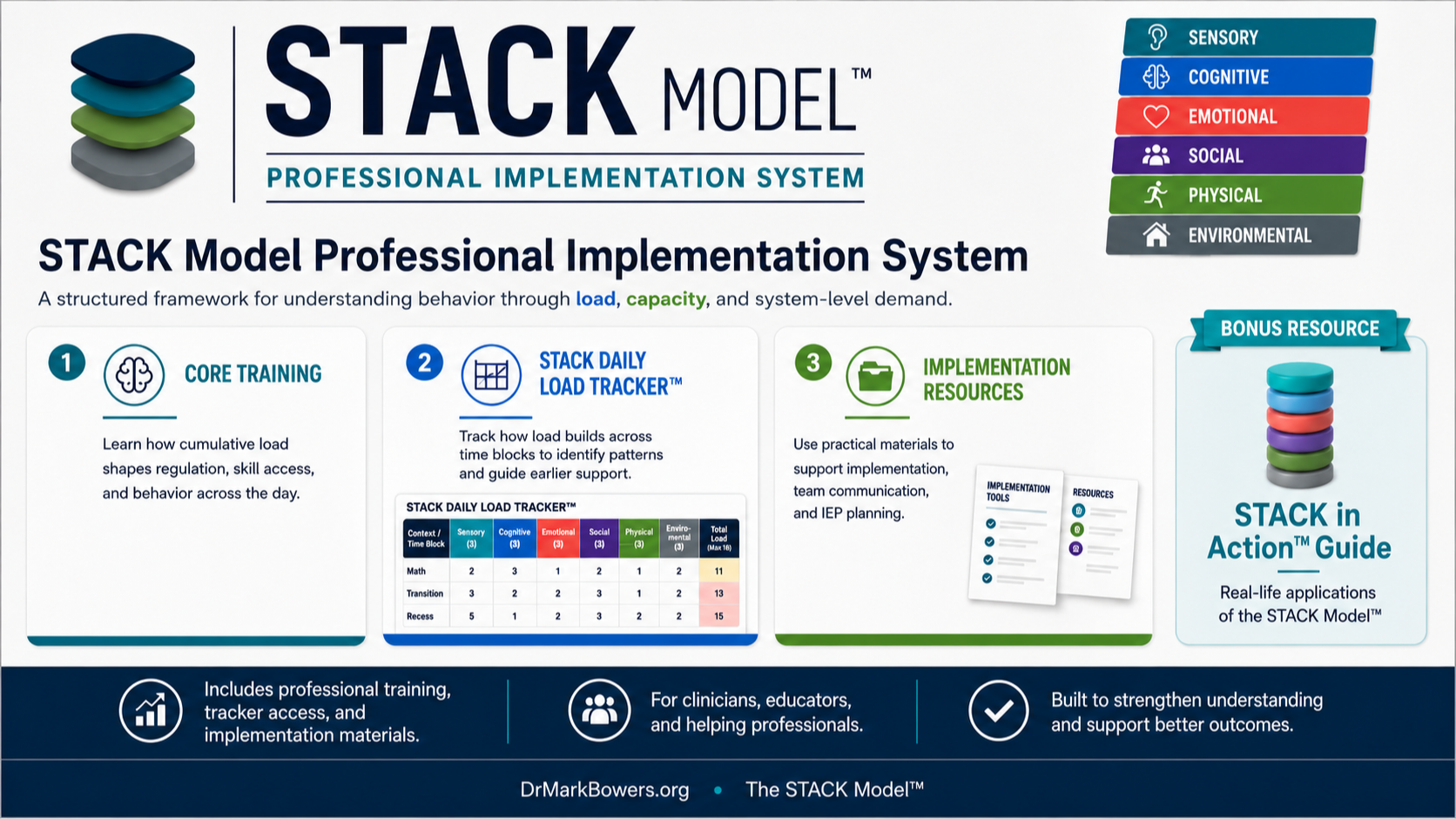
The STACK Professional Implementation System™ gives professionals a structured way to apply the model across school, clinical, IEP, and team-based settings.
The system helps you:
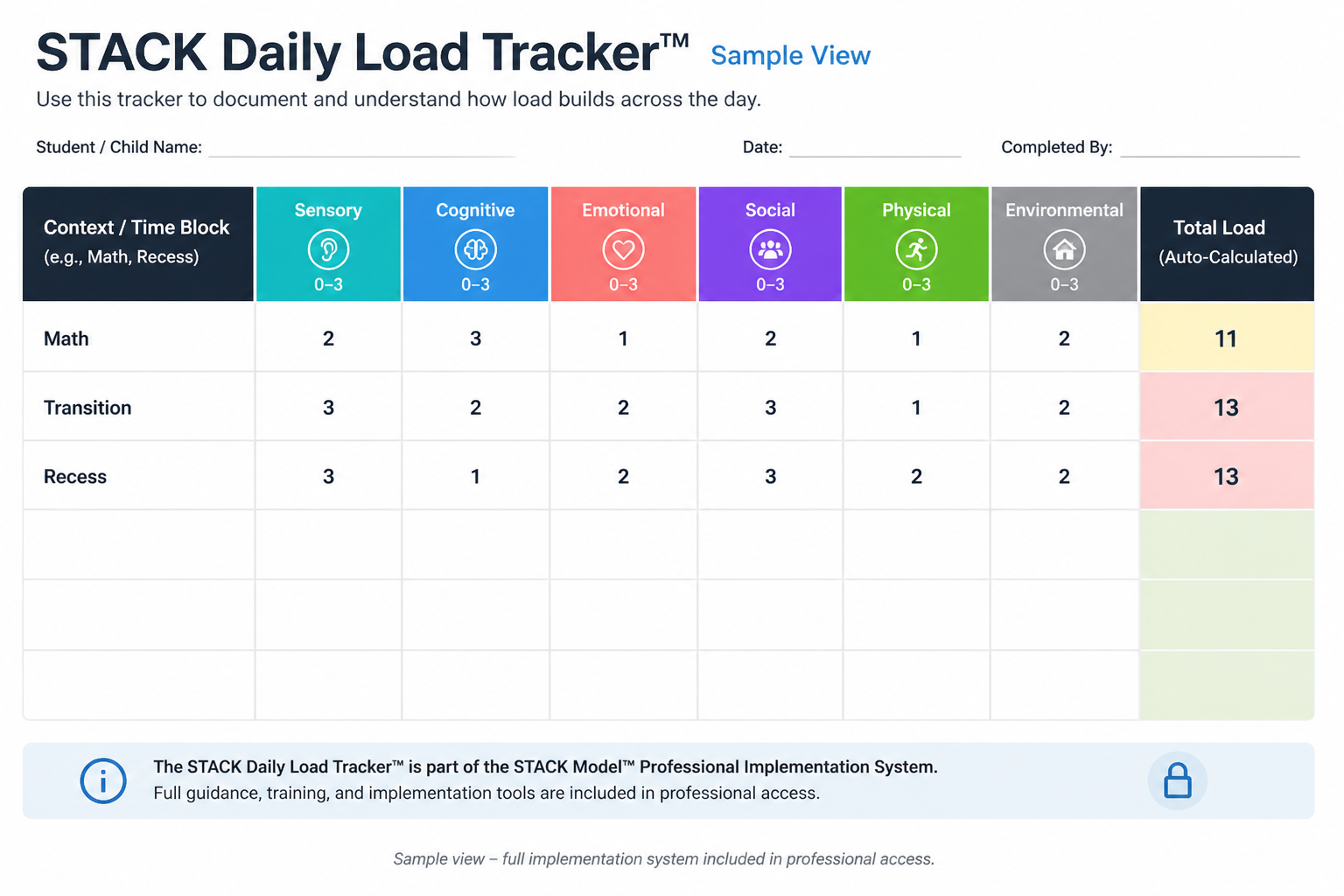
Track how load builds across the day
See what a person is carrying before behavior changes
Recognize when capacity is being reached
Identify early signs of overload
Decide what to adjust and when
Use a shared framework across teams
Inside the system, you receive:
Full professional training
-
The Google Sheets-based STACK Daily Load Tracker™
-
Tracker use instructions
-
Implementation guidance
-
Clinical toolkit
-
IEP one-page overview
-
Load definitions
-
Real-world examples
The goal is not just to track behavior.
The goal is to understand how load builds across the day so patterns become visible before behavior escalates.
What Changes When Teams Track Load
When teams begin looking at load before behavior, they can make decisions earlier and more consistently.
The system supports:
Earlier intervention
Better recognition of patterns
More consistent team decisions
Clearer conversations across home, school, and clinical settings
Less guesswork in moments of escalation
A shared language for understanding behavior
Instead of reacting after behavior, teams can begin addressing the load that leads to it.
Start Using the STACK Model™
in Real Time
Get access to the STACK Professional Implementation System™ and begin applying the model in the moments where decisions matter most.
You’ll receive professional training, the STACK Daily Load Tracker™, implementation guidance, clinical and school-based tools, load definitions, and real-world examples.
Use the system to track how load builds, recognize early signs of overload, and make more consistent decisions before behavior escalates.