
STACK Professional Implementation System™
A structured professional system for understanding behavior through the interaction of load, capacity, and cumulative demand across the day.
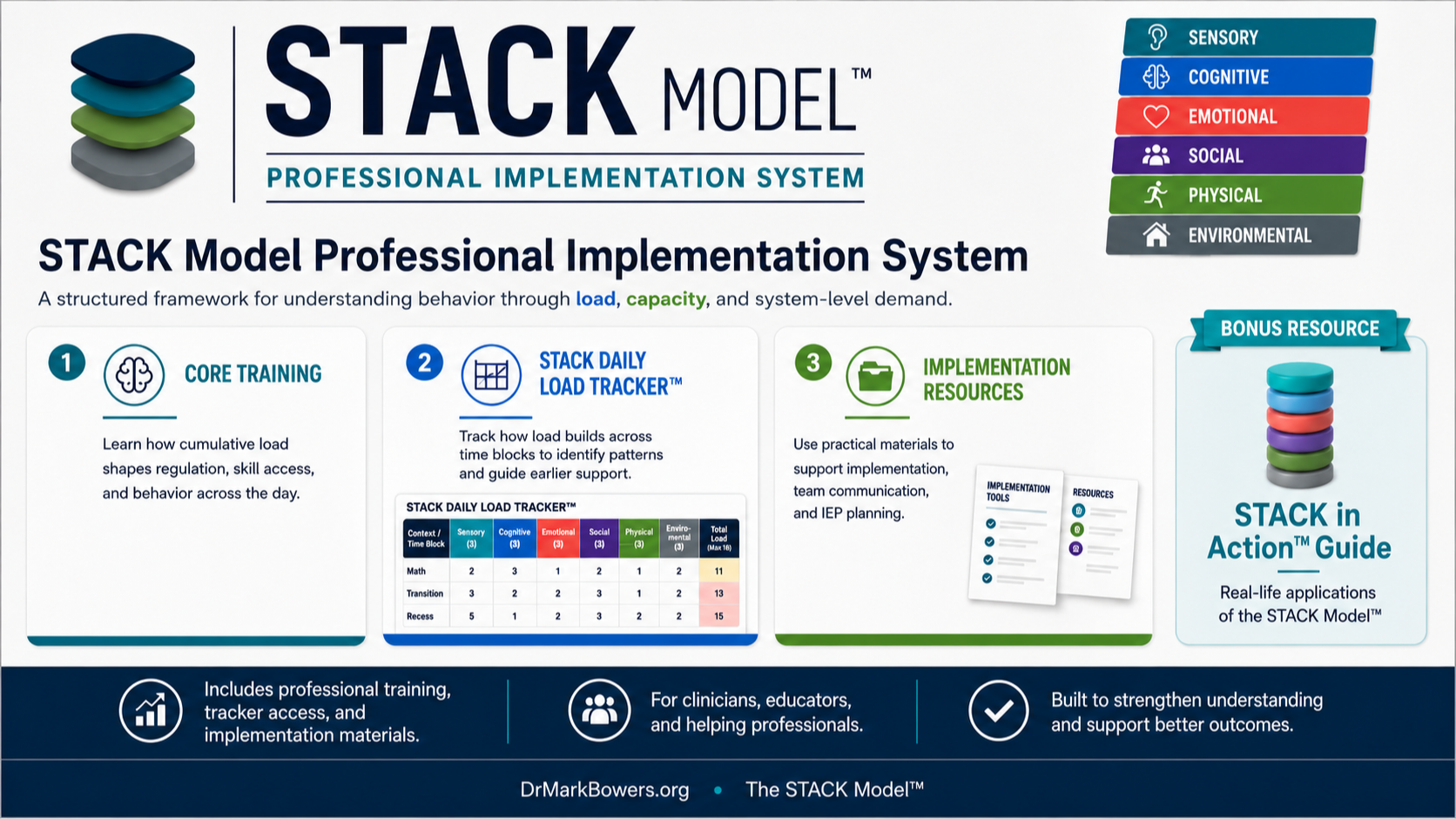
This system helps clinicians, educators, consultants, and school-support professionals apply the STACK Model™ in real-world settings through professional training, a Google Sheets-based daily load tracker, implementation tools, school-support resources, reproducible handouts, and applied examples.
The goal is not simply to track behavior.
The goal is to understand what may be building underneath behavior, identify patterns of load, support capacity earlier, and improve the timing of intervention.
Included Resources
Core Professional Training
The core training introduces the STACK Model™ framework and explains how cumulative load, capacity, and access to skills interact across the day.
You will learn how to use the model to better understand behavior, identify patterns, and support more accurate interpretation and response.
STACK Daily Load Tracker™
The STACK Daily Load Tracker™ is a Google Sheets-based implementation tool designed to help professionals identify cumulative load patterns across the day.
The tracker supports:
- Daily load tracking
- Six-domain load ratings
- Pattern review
- Dashboard review
- Early signal identification
- Support planning
- Team-based discussion
The tracker is not simply a behavior log. It is designed to help teams recognize when capacity may be narrowing and adjust support before behavior escalates.
STACK Tracker Quick Start
The Quick Start Guide helps users begin using the tracker without getting overwhelmed.
It includes guidance for:
- Creating a working copy
- Understanding the tracker tabs
- Using the rating scale
- Reviewing the six load domains
- Sharing the tracker appropriately
- Understanding use boundaries and permissions
STACK Brief Overview
The brief overview provides a concise explanation of the STACK Model™ for professional reference, team orientation, and basic model explanation.
Use this resource when you need to explain:
- What the STACK Model™ is
- How cumulative load builds
- Why behavior may shift when load exceeds capacity
- Why skill access may change across the day
- How the model supports clearer and more compassionate responses
STACK Clinical Toolkit
The Clinical Toolkit is the main professional working toolkit in the system.
It includes structured tools for:
- Mapping baseline load factors
- Completing a rapid scan of current load
- Identifying early signs before escalation
- Reviewing difficult moments through a load-capacity lens
- Sequencing intervention when escalation begins
- Supporting more consistent school and team language
This toolkit is designed for use in clinical work, consultation, parent coaching, school support, post-incident reflection, and implementation planning.
STACK Reproducible Professional Handouts
These handouts are designed for direct professional use with clients, families, students, and school teams.
They help explain:
- What the STACK Model™ is
- The six STACK load domains
- What may already be on the STACK before behavior changes
- How to lower one load first
These are the designated reproducible handouts included in the professional system.
STACK IEP Team Overview
This school-support resource helps teams apply the STACK Model™ during IEP meetings, student support planning, consultation, and home-school collaboration.
It helps teams shift from debating behavior to understanding:
- What the student may be carrying across the day
- Where demands may be accumulating
- How load and capacity affect access to skills
- How teams can support proactive adjustments
STACK IEP Examples
This resource provides sample STACK-informed IEP goal examples, short-term objectives, and benchmarks.
It can help teams think about goals related to:
- Identifying elevated load domains
- Recognizing early signs of rising load
- Using load-reduction supports
- Building capacity and recovery routines
- Generalizing STACK thinking across settings
- Communicating needs and returning differently to tasks or expectations
These examples are for professional discussion and should always be individualized based on the student’s needs, evaluation data, present levels of performance, and local requirements.
STACK in Action™ Bonus Guide
The STACK in Action™ Bonus Guide shows how the STACK Model™ can be applied to common real-life situations.
Examples include:
- Homework refusal
- Bedtime meltdowns
- After-school collapse
- School transitions
- Therapy skill carryover
- Screen battles
- Camp and summer overload
- Classroom shutdown
- Public place meltdowns
- Morning routine battles
This bonus guide helps connect the model to practical moments that occur across home, school, therapy, and community settings.
Who This Is For
This professional system is designed for:
- Psychologists
- Therapists
- Counselors
- Social workers
- School psychologists
- Special education professionals
- Consultants
- Parent coaches
- Educators and school-support teams
- Professionals supporting neurodivergent children, students, and families
Professional Use & Licensing
The STACK Professional Implementation System™ and the STACK Daily Load Tracker™ are intended for use as provided within the STACK Model™ framework.
Purchasers may create their own working copy of the tracker and share that working copy only with team members directly involved in supporting the specific child, student, client, classroom, or case being supported.
The tracker, master tracker link, downloads, course materials, and professional resources may not be shared, posted, redistributed, reproduced, resold, modified into alternate versions, or adapted into a separate spreadsheet, tool, training, product, or derivative version without written permission.
The STACK Reproducible Professional Handouts are the designated handouts that may be reproduced for direct use with clients, families, students, and teams served by the purchasing professional.
All other materials are provided for professional learning, reference, consultation, implementation, and direct professional service use unless otherwise stated.
Important Note
The STACK Model™ is a professional framework for understanding behavior through load, capacity, and cumulative demand.
It is not a diagnostic tool and does not replace professional judgment, clinical decision-making, educational planning, or individualized evaluation.
The goal is to help adults ask better questions earlier:
-
What load may be building?
-
Which domains are elevated?
-
What early signs are appearing?
-
What can be reduced first?
-
What support may restore capacity?
-
When should expectations be reintroduced?