
The STACK Model™
A Load-Based Capacity Framework for Interpreting Behavioral Overwhelm in Children
Developed by Mark Bowers, Ph.D. 2026
The STACK Model™
A Load–Capacity Framework for Interpreting Behavioral Overwhelm
The STACK Model™ is a load-based capacity framework for understanding behavioral escalation in children and adolescents.
The model proposes that observable behavioral shifts occur when accumulated multi-domain demands exceed available regulatory capacity.
When cumulative load crosses a Capacity Threshold, behavior shifts from flexible engagement to Protection Mode.
The STACK Model™ provides a structured sequencing principle for intervention across clinical, educational, and caregiving contexts.
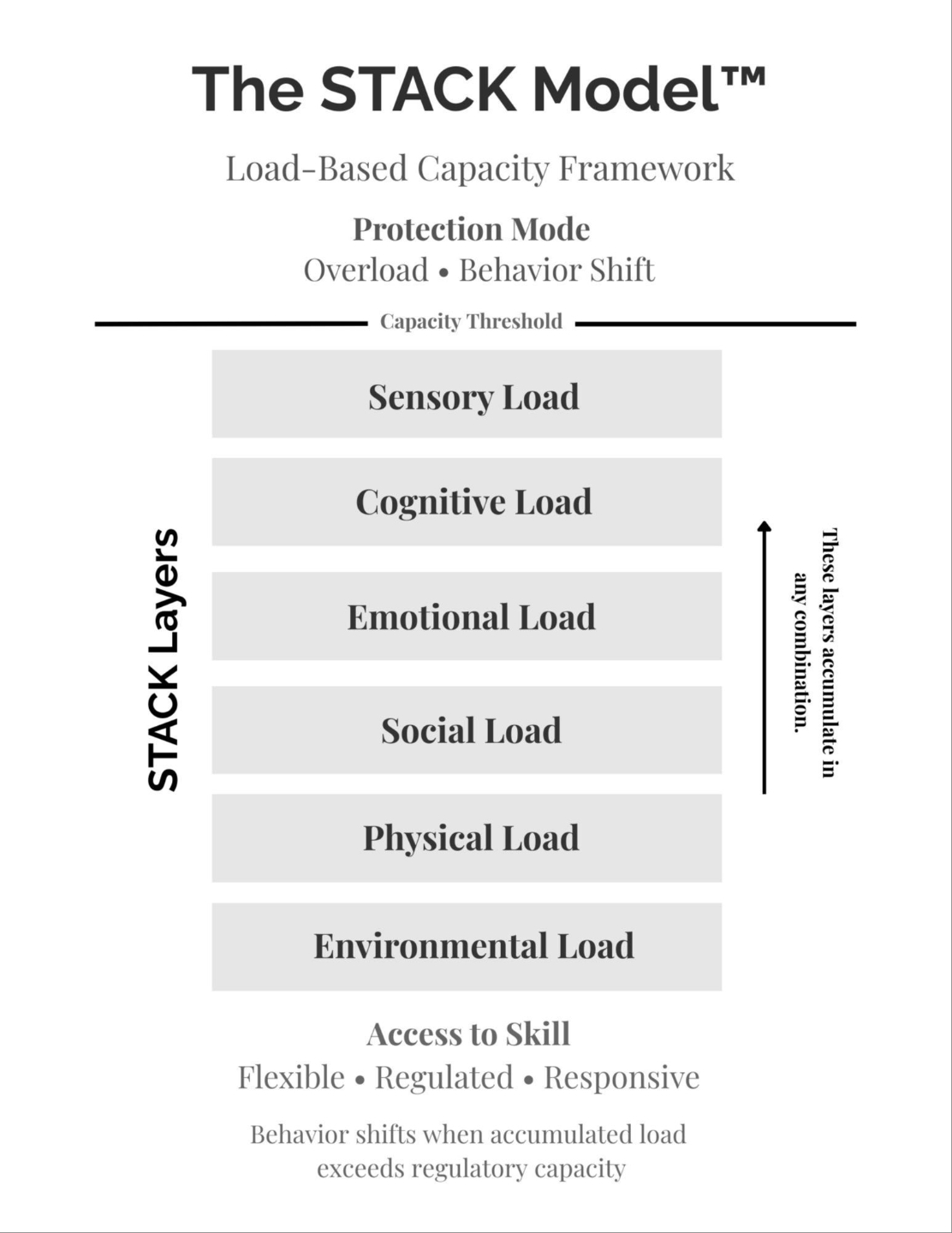
Core Components of the STACK Model™
Multi-Domain Load
Load refers to the total regulatory demand placed on the nervous system across interacting domains:
• Sensory load (noise, lighting, tactile input)
• Cognitive load (transitions, task complexity, time pressure)
• Emotional load (frustration, uncertainty, disappointment)
• Social load (peer interaction, performance expectations)
• Physical load (fatigue, hunger, illness)
• Environmental load (pace, unpredictability, crowding)
Load is additive and context-dependent.
Regulatory Capacity
Regulatory capacity refers to the available neurocognitive and autonomic resources required for:
• Executive functioning
• Emotional modulation
• Behavioral inhibition
• Social responsiveness
Capacity fluctuates across time and context.
The Capacity Threshold
The Capacity Threshold represents the point at which cumulative load exceeds available regulatory bandwidth.
When crossed, behavior shifts.
Protection Mode
Protection Mode is the functional behavioral state that emerges when capacity is exceeded.
It may include:
• Meltdown
• Shutdown
• Refusal
• Rigidity
• Withdrawal
• Aggression
Protection Mode reflects overload rather than strategic opposition.
The STACK Model™ Sequencing Principle
Intervention sequence matters.
-
Interpret load before intent.
-
Reduce load before correction.
-
Restore capacity before skill demand.
-
Repair after stabilization.
The model prioritizes state before strategy.
Accountability and expectation remain essential, but are sequenced after regulation.
Applied Interpretation Example
A student refuses a task late in the school day.
Traditional interpretation:
Noncompliance or avoidance.
STACK interpretation:
Cumulative load from transitions, sensory input, social demands, and fatigue has exceeded available capacity.
Intervention sequence:
• Reduce immediate load
• Support physiological regulation
• Simplify task demand
• Reintroduce expectation once capacity returns
When capacity is restored, access to skills often re-emerges without additional instruction.
Distinction From Related Frameworks
The STACK Model™ complements but differs from related approaches:
Cognitive Behavioral Models
Focus: Strategy acquisition
STACK Distinction: Strategy access depends on regulatory capacity.
Sensory Processing Models
Focus: Sensory modulation
STACK Distinction: Sensory load is integrated within multi-domain accumulation.
Trauma-Informed Care
Focus: Past threat exposure
STACK Distinction: Emphasizes present cumulative load and real-time threshold dynamics.
Spoon Theory
Focus: Energy expenditure across time
STACK Distinction: Focuses on simultaneous load accumulation and threshold crossing.
Scope and Limitations
The STACK Model™:
-
Is not a diagnostic instrument
-
Is not a standalone treatment protocol
-
Does not replace therapeutic or medical care
-
Does not eliminate neurodevelopmental differences
-
Does not assume all behavior is threshold-based
The model is a decision-making framework intended to improve behavioral interpretation, timing of intervention, and environmental alignment.
Professional Engagement
The STACK Model™ is available for:
-
Clinical training
-
School consultation
-
Professional workshops
-
Interdisciplinary implementation
-
Conceptual research collaboration
For professional inquiries, training requests, or academic collaboration, contact: [email protected].
Selected Theoretical Foundations
• Cognitive load theory
• Executive function under stress
• Stress–performance threshold research
• Resilience development theory
Full references are available in the White Paper.
Bowers, M. (2026). The STACK Model™: A Load-Based Capacity Framework for Interpreting Behavioral Overwhelm in Children. Retrieved from https://www.drmarkbowers.org/stack-model-white-paper
© 2026 Mark Bowers. All rights reserved.Professional Inquiries
For training, consultation, research collaboration, or implementation inquiries related to the STACK Model™, please contact [email protected].